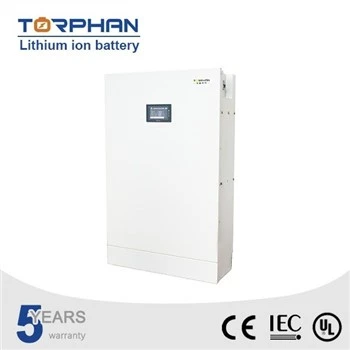
Datasheet values (Li-W 51100)
| Item | Li-W 51100 |
|---|---|
| Rated voltage | 51.2 Vdc |
| Rated capacity | 100 Ah |
| System energy | 5.12 kWh |
| Working voltage range | 48~57.6 Vdc |
| Depth of discharge | 96% |
| Max charge current | 20 A |
| Max discharge current | 20 A |
| Cycle life | >7000 |
| Charge temperature range | 0 to 50 C |
| Discharge temperature range | -20 to 55 C |
| Storage temperature range | -30 to 60 C |
| Size (L x W x H) | 480 x 180 x 850 mm |
| Weight | 60 kg |
| Parallel connection | 6 pcs |
Read the table the way an installer does. The 20 A maximum charge and discharge currents are the working limits of this unit — about 1 kW of continuous power at the 51.2V platform — so the 51100 is sized for essential-load backup and solar self-consumption rather than whole-home high-draw duty. Homes whose load list includes large simultaneous draws should step up to the 206 Ah or 280 Ah wall units, whose limits are 50 A and 100 A; the full Li-W table is reproduced on the Power Wall page of this site.
Built-in smart BMS and inverter communication
The Power Wall record for this series specifies an in-house smart BMS: automatic control and protection against overheating, over-voltage and over-current, an optional LCD display showing state of charge, voltage, temperature and charge and discharge current, and communication with the inverter and charger over CANbus and RS485. That communication is what lets the wall battery charge from the array at midday and discharge through the evening peak as one supervised system, instead of a battery and an inverter guessing at each other.
What 5.12 kWh actually runs
At the 96% depth of discharge, about 4.9 kWh is usable before inverter losses. On the usual assumption of a refrigerator and freezer drawing roughly 1 to 1.5 kWh across a day, LED lighting for the evening hours, a router and devices, and a few hours of television — an overnight essentials total of roughly 2 to 3 kWh — that usable figure covers the essentials list through the night, or the evening shoulder of a solar home's consumption, charged from the array at midday. It is not sized for electric water heating or air conditioning overnight; those loads belong in the quote discussion for the larger wall units.
Growing the bank
The Li-W series records parallel connection of up to six units, so a home that starts with one 51100 can grow to a bank of about 30 kWh in the same format, unit by unit, as the load list grows. Parallel expansion is specified within the series: state the number of units you plan to run together, and the quote confirms the parallel configuration and the inverter pairing for the bank.
Ordering
Send the inverter the battery will pair with, the loads the unit must carry, and the quantity — including any future parallel units you already plan. The quote confirms communication pairing and mounting hardware against the Li-W 51100 record. Minimum order quantities and lead times are confirmed on quotation.