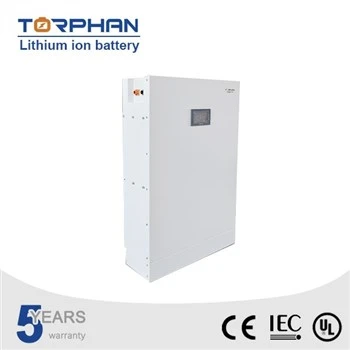
The 12V solar unit
| Item | TF206AH1P4S |
|---|---|
| Rated voltage | 12.8 Vdc |
| Rated capacity | 206 Ah |
| Rated energy | 2.63 kWh |
| Module configuration | 1P4S |
| Working voltage range | 11.2~14.4 Vdc |
| Standard charge current | 100 A |
| Standard discharge current | 100 A |
| Max charge current (30 s) | 200 A |
| Max discharge current (30 s) | 200 A |
| Size (L x W x H) | 266 x 180 x 245 mm |
| Weight | 22 kg |
| Charge temperature range | 0 to 50 C |
| Discharge temperature range | -20 to 55 C |
| Storage temperature range | -30 to 60 C |
The 12V unit's protection is explicit: its built-in Battery Protection System shuts the battery down if it is drained below 8V or charged above 15.8V. Advantages for the unit are half the weight and double the power of the lead-acid equivalent, a drop-in replacement for lead-acid, gel or AGM batteries, and a service life of 3000 to 5000 cycles.
The 51.2V solar storage step
For whole-home and commercial solar, the range steps to the 51.2V wall series (5.12, 10.5 and 14.3 kWh, over 7000 cycles, 96% depth of discharge) and home systems up to 28.6 kWh, all with smart BMS and CAN/RS485 inverter communication. At solar-farm scale the same chemistry sits in the 512 Vdc container platform with at least 5000 cycles.
Why LFP fits solar duty specifically
The solar case emphasises durability, efficiency and resilience: LFP tolerates high temperatures with minimal degradation, holds charge in storage with a self-discharge under 3% per month, and needs no watering or equalisation across its life. Round-trip efficiency for the lithium line is 98%, which over a decade of daily cycles is a large amount of recovered energy compared with lead-acid banks.
Specifying a solar battery
Send the array size, whether the system is on-grid, off-grid or hybrid, and the nightly load you want covered. The quote matches the unit family and capacity. Minimum order quantities and lead times are confirmed on quotation.
Matching the battery to the array size
As a sizing orientation from the range: small off-grid and backup systems (lighting, communications, a cabin) sit comfortably on the 12.8V 206 Ah unit at 2.63 kWh. A family home running solar self-consumption typically multiplies that energy by two to five, which is the 51.2V wall series territory at 5.12, 10.5 and 14.3 kWh. Commercial arrays and solar farms leave the wall format behind and specify the container platform. The sizing guide on this site's blog works the arithmetic in full for the home case.