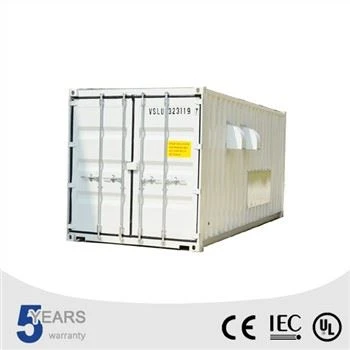
Datasheet values
| Item | Specification |
|---|---|
| Rated capacity | 500 Ah (800 pcs 3.2 V 100 Ah LiFePO4 cells, 160S5P) |
| Rated voltage | 512 Vdc |
| Max voltage | 584 Vdc |
| Min voltage | 448 Vdc |
| Max output power | 150 kW |
| Output voltage | 120 Vac / 240 Vac, 60 Hz |
| Energy transform efficiency | >=90% |
| Cooling type | Air cooling |
| Noise | <=65 dB |
| Protection level | NEMA 3R |
| Container type | 40GP |
| Communication | CAN / RS485 / MODBUS |
| Cycle life | >=5000 cycles |
The bank is built from 800 3.2V 100 Ah LiFePO4 cells in a 160S5P configuration. Output is 120 Vac / 240 Vac at 60 Hz with a maximum output power of 150 kW, air cooling, a noise level at or below 65 dB and a NEMA 3R protection rating for outdoor installation. Charge and discharge current ratings are fixed per project in the written specification, against the cell configuration and the inverter pairing of the build — send the duty the system must cover and the quote states the current ratings for that configuration.
Feature set
The container system carries the features a plant operator actually checks: 100% emission-free clean technology, full performance in cold conditions, accurate state of charge from the integrated battery management system, scalable energy storage, cobalt-free LiFePO4 chemistry, a 98% efficiency rate, with system efficiency of at least 90% including charge and discharge, fast charge and discharge rates, no thermal runaway with fire propagation, and cycling from once to several times per day. Built-in safety includes a breaker, fuses and relays with an on/off switch for shipping and installation.
Where container ESS is used
Duties for this platform class are solar battery storage for energy systems and solar energy storage systems generally: utility and commercial solar farms shifting generation into the evening, industrial sites shaving demand peaks, and remote or weak-grid sites needing firm capacity. Parallel containers take the same design from hundreds of kWh into multi-container plants without re-engineering the unit.
Specifying a container project
Send the required usable kWh, the peak kW the system must deliver, the grid or off-grid duty, and the site's communication requirements. The quote is built on the platform above, with container count and inverter specification confirmed. Minimum order quantities and lead times are confirmed on quotation.