First: confirm your system voltage
A cart's system voltage is set by its motor and controller, and the lithium pack must match it. The range covers both: 48V lithium golf cart batteries as a major line, and 36V lithium golf cart batteries as a dedicated model family for older and utility carts. Check the existing battery bank (six 6V or six 8V batteries suggests 36V or 48V respectively; the charger and the cart's data plate confirm it) before pricing anything — a 36V cart cannot take a 48V pack, and vice versa.
What the conversion involves
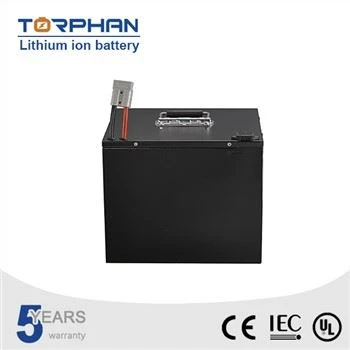
The Torphan position is a turn-key replacement system that converts a cart from lead acid to a lithium battery pack in under one hour, using the same wiring as the current lead-acid setup. In practice a conversion kit for this class of cart comprises the LiFePO4 pack itself with its built-in BMS, the mounting arrangement for the battery compartment, and — where the existing charger is a lead-acid-only unit — a matched lithium charger. The old bank comes out as a set, the single pack goes in, and the wiring lands on the new terminals. The weight difference is felt immediately: the lithium lines weigh roughly a third of the lead-acid equivalent, which is why converted carts accelerate and climb better even at the same nominal capacity.
What changes after conversion
Charging changes first: the manufacturer's golf cart battery line offers fast charging during breaks, so a cart can be ready between rounds instead of only overnight, and low self-discharge — a feature of the golf cart datasheet — means it is still ready after weeks parked. Maintenance changes second: no watering, no equalisation charges, no terminal corrosion to clean, no acid to handle or spill. On the 48V line, the sealed pack's built-in BMS protects against overcharge, over-discharge, over-current and short circuit, and the 72V-class golf cart datasheet lists over-temperature protection and an under-voltage alarm among its protection functions; the 36V pack's own datasheet sets out its current and temperature limits instead of a named protection set, so that set is one to have stated in the quote. Longevity changes third: the golf cart battery listings state a 5-year warranty and long life expectancy for the line — ask for the cycle-life figure of the specific pack quoted, because that number, not a range-wide comparison, decides how many seasons one pack covers.
36V versus 48V conversion notes
The work is the same; the details differ. On 36V carts — often older fleet and utility vehicles — check the compartment dimensions carefully, because the original bank layout varies more, and confirm the charger: many 36V lead-acid chargers have profiles unsuitable for lithium, making the matched charger part of the sensible quote. On 48V carts, the drop-in replacement programme covers the major cart platforms, and the pack options are deeper. Temperature behaviour matters on carts that live outdoors, and it is specified differently by line: the 36V pack's charge window starts at 0°C, while the 48V line's built-in high-temperature cut-off stops charging above 50°C (122°F). Have the temperature specification of the pack in your quote confirmed in writing.
Getting a conversion quote
Send the cart brand and model, the system voltage, and whether you need a charger included. State fleet quantity if you run resort, rental or course carts — conversions are routinely done as a fleet programme, cart by cart, in the same under-an-hour pattern. The reply specifies the pack for your voltage class and the charger decision in writing, so there are no surprises at installation.
Costs and payback
A conversion quote has three parts: the pack, the charger (where the old lead-acid charger is unsuitable), and any mounting hardware. Against that, the offsets are the ones a fleet can price from its own records: the bank replacements avoided over the pack's service life (the golf cart listings state a 5-year warranty, and the quote should state the cycle-life figure for the pack specified); charging energy and time savings from the faster, more efficient charge; and the removal of watering, cleaning and equalisation labour. For a private cart the payback is mostly convenience and reliability. For a fleet of course or resort carts, where each cart's bank replacement and weekly battery care are budget lines, the payback period is set by those two lines against the pack, charger and hardware prices — run them against your own duty cycle rather than accepting a fixed period from any supplier.
Questions to ask before you order
Four questions settle a conversion. Is the pack a listed model for my voltage class, with a datasheet, or a generic assembly? Is the BMS built in, and which protections does the pack's own datasheet name? Is my existing charger compatible, in writing, or is a matched charger included? And what is the cycle-life figure behind the pack — the figure the manufacturer states for that model, which is the number that decides whether the conversion is a five-year or a fifteen-year decision. The quote form on this site is built around those questions; send the cart details and the answers come back with the price.
After the conversion: the new routine
Post-conversion life is simpler but not entirely habit-free. Charge with the matched lithium charger and let the BMS end the session; there is no watering schedule to keep and no equalisation day to remember. For storage, the lithium self-discharge of under 3% per month means a cart parked for a season wakes up with most of its charge, though storing at a partial charge and checking occasionally remains good practice on any lithium system. Keep terminals clean and tight as you would on any vehicle battery, and note the pack's behaviour in the first weeks — range and hill performance consistently better than the old bank is the normal report, and any shortfall is worth raising with the supplier while the installation is fresh.
The decision in one paragraph
If your cart's lead-acid bank is due for replacement, the conversion decision is rarely lithium versus a new lead-acid bank on price alone: it is one sealed, fast-charging, maintenance-free pack with a multi-thousand-cycle life, against another round of the watering, cleaning and mid-life replacement routine you already know. For most carts that do real work, that is not a close call.
Both voltage pages — 48V and 36V lithium golf cart batteries — carry the product position behind this guide, so the conversion can be specified from the manufacturer's own listings.