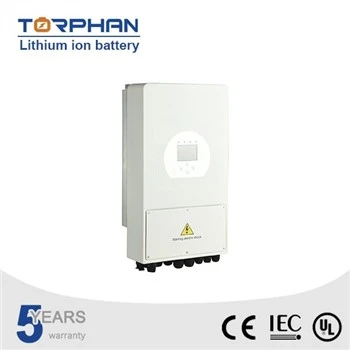
On-grid (grid-tied) with storage
In a grid-tied system the array and the house both connect to the grid; the battery sits between them, charging from surplus solar at midday and discharging through the evening peak. The grid remains the backup, so the battery is sized on economics — evening consumption — not survival. The home systems are described for exactly this duty: charge your battery with solar or the grid in the morning to avoid paying peak rates in the afternoon and evening, and pair the battery with solar panels to bring the bill down further, since solar production stops around 4pm, right when peak prices start. The building blocks: the 5.12 to 14.3 kWh Li-W wall units at home scale, sized by the evening load as worked through in this site's sizing guide.
Off-grid systems
Off-grid, there is no grid to fall back on, so the battery bank is the power system: it must cover night load, days of low generation, and the surge of motor loads. The Torphan position serves this duty with LiFePO4 banks that parallel modularly — wall units up to six in parallel, so six 5.12 kWh units form a bank of about 30 kWh before a site steps up in format — the 28.6 kWh home system, and at remote-site scale the 512 Vdc container platform with 100% depth of discharge capability and at least 5000 cycles. Off-grid sizing adds autonomy days to the load-list arithmetic, and it favours LFP's strengths: low self-discharge under 3% per month, tolerance of high temperatures with minimal degradation, and no maintenance visits for watering or equalisation — decisive on sites that are visited monthly, not daily.
Hybrid systems
A hybrid system stays grid-connected but behaves like an off-grid system when the grid fails: it self-consumes solar in normal operation and islands the critical loads during an outage. The home system design is described in precisely these terms — an integrated microgrid design that operates in both off-grid and grid-connected modes with seamless switching between them, greatly improving the reliability of the power supply, with a management system that adjusts the operating strategy according to the grid, the load, the storage and the electricity price. The wall-module family is likewise built for off-grid and hybrid systems. Hybrid is where most residential and small commercial projects land, because it monetises the battery daily (self-consumption and peak shaving) while keeping the backup function that justified it emotionally.
The components every architecture shares
Whichever architecture is chosen, the same three components do the work: the battery bank, the inverter/charger, and the battery management system. The Torphan storage design treats them as one system — the BMS monitors current, voltage and temperature and communicates with the inverter over CANbus or RS485; the inverter is a multi-functional unit combining MPPT solar charging, pure sine wave inversion and a UPS function module, with automatic restart when AC power recovers. Specifying them together, with communication proven between the parts, is the difference between a system and a pile of equipment.
Choosing your architecture
Start with two questions. Does the site have a reliable grid? If not, off-grid sizing rules apply. Is the goal bill reduction, backup, or both? Bill reduction points on-grid; both points hybrid. Then size the bank from the load list as the home battery backup guide sets out, and send the array size, architecture and load list with your inquiry — the reply matches units and the inverter interface to the design.
Sizing notes per architecture
The architecture changes the sizing question. On-grid storage is sized against the evening peak it must cover and the tariff spread it arbitrages — a few kWh, deeply cycled, pays back fastest. Off-grid storage is sized against autonomy: the load list multiplied by the days of reserve the site demands, at the 96% depth of discharge for the wall series. Hybrid sizing takes the larger of the two logics — usually the backup load list with solar self-consumption as the daily duty — and it is the case the home systems describe most directly, with seamless grid/off-grid switching and price-aware operation built into the management system.
Why the battery chemistry is the same in all three
It is tempting to treat home, commercial and solar-farm storage as different products; electrically they are the same decision repeated. Daily cycling, indoor or outdoor unattended operation, and a decade of expected life all point to lithium iron phosphate, and the range reflects that: one chemistry from the 12.8V solar unit through the 51.2V wall cabinets to the 512V container, with the same BMS platform concepts — state of charge, protection, balancing, communication — repeated at every scale. Specifying one platform across a portfolio of sites simplifies spares, monitoring and operator training in exactly the way a single truck battery platform does for a forklift fleet.
A short specification checklist for any of the three
Whichever architecture you choose, the same five specification items should appear in any serious proposal, and each maps to a feature of the range. Chemistry and cycle life at a stated depth of discharge (LFP, 96% DoD, 7000-plus cycles on the wall series). Communication between battery, inverter and charger (CANbus and RS485 from the smart BMS). Protection hardware (breaker, fuses, relays, on/off isolation). System efficiency (at least 90% for the container platform, and a 98% efficiency rate for the lithium line). And operating modes with automatic switching (the seamless grid/off-grid changeover). A quote that omits any of the five is not yet a system design — ask for it in writing before comparing prices.
Where to go next
The product pages linked from this guide carry the units for each architecture — wall batteries and home systems for residential projects, cabinets and the container platform for commercial and solar-farm work. Bring your architecture decision and your load list to the quote form, and the specification comes back in named products rather than generic promises.